

Best Learn Spanish App Game: 12 Tested Picks for 2026

Updated: May 18

TL;DR
Most apps marketed as a "learn Spanish app game" are just quiz apps wearing a game costume. The real divide is between game first apps (where gameplay drives learning) and gamified drill apps (where points and streaks are layered onto flashcards). For genuine gaming with built in language learning, Lingo Legend and LangLandia stand out. For a free starting point with gamified exercises, Duolingo still works. For niche practice like verb conjugation drills or crossword puzzles, smaller focused tools fill gaps the bigger apps miss. This guide covers 12 tested options across both categories, with honest tradeoffs and pricing for each.
Why Most "Game" Apps Aren't Really Games
Here's the problem with searching for a learn Spanish app game: almost everything that shows up is a traditional lesson app with confetti animations and XP bars stapled on top. Remove the streak counter and the leaderboard from most of these apps and you're left with multiple choice flashcards. That's not a game. That's a quiz with a reward system.
This matters because the word "game" in your search is doing real work. You want something you'd actually enjoy playing, something with strategy, narrative, or competition that happens to teach you Spanish along the way.
Spanish is the world's most studied language on major platforms. Duolingo's own data shows Spanish tops their list of courses with the most serious learners, and with roughly 560 million speakers globally, the demand for engaging study tools is enormous. Yet the supply of genuinely game based Spanish learning apps remains surprisingly thin.
This guide separates the real games from the gamified drills. Every app here was evaluated on gameplay depth, learning methodology, pricing transparency, and what actual users say about them. If you want to understand how game based vocabulary practice actually sticks, the science of spaced repetition scheduling is worth reading alongside this guide.
At a Glance Comparison Table
What Makes a Spanish Learning "Game" Different From a "Gamified App"
This distinction is the single most important thing to understand before picking an app.
A game has its own narrative, strategic decisions, progression systems, and replay value. You'd play it even if it weren't teaching you anything. The learning happens because it's woven into the mechanics: you answer vocabulary questions to power attacks, complete grammar exercises to harvest crops, or translate sentences to advance through a story.
A gamified app takes traditional exercises (matching, fill in the blank, multiple choice) and adds points, streaks, hearts, and leaderboards. Strip away the reward layer and you have digital flashcards.
Why does this matter? A 2024 review in Frontiers in Education found that mobile assisted vocabulary learning shows "superior retention rates compared to traditional paper based methods," and that gamification elements like rewards, points, and levels enhance learner engagement. But the research also highlights that spaced repetition, which schedules reviews at optimal intervals before you forget, is the backbone of durable memory formation. For a deeper explanation of how SRS works under the hood, that guide breaks down the science.
The best Spanish learning game apps combine both: real gameplay that keeps you coming back, plus spaced repetition that ensures you actually remember what you studied. Understanding this difference is critical when choosing any learn Spanish app game, because labels on app stores rarely tell you which category a product falls into.
Why Adaptive Difficulty Matters More Than You Think
One feature that separates effective learning games from shallow ones is adaptive difficulty. This is the system that adjusts how hard your exercises are based on how well you're performing in real time.
In a static app, every learner gets the same questions at the same pace. If you already know basic food vocabulary, you still grind through "manzana" for the tenth time. Adaptive difficulty solves this by bumping you to harder material when you're getting things right and pulling back when you're struggling.
Practitioners on Reddit frequently mention this as a dealbreaker. In language learning forums, users describe how apps without adaptive difficulty feel "too easy after a week" or "suddenly impossible with no in between." The apps that handle this well (Lingo Legend's increasing difficulty levels, Clozemaster's frequency based word tiers, Duolingo's spaced exercise scaling) keep learners in what psychologists call the "zone of proximal development," challenged enough to grow but not so overwhelmed they quit.
When evaluating any learn Spanish app game, ask: does it get harder as I improve, or does it just serve the same difficulty forever?
Progress Tracking: How to Know You're Actually Learning
The other feature worth demanding from any Spanish game app is meaningful progress tracking. Not just XP totals or streak counts, but data that tells you something useful: how many words you've mastered versus how many you're still reviewing, which categories give you trouble, and how your recall rate changes over time.
Good progress tracking serves two purposes. First, it lets you see genuine improvement, which sustains motivation better than any badge system. Second, it reveals weak spots. If your progress dashboard shows you nail food vocabulary but struggle with verb forms, you know exactly where to focus next.
Lingo Legend provides detailed metrics on words learned, review accuracy, and category progress. Clozemaster goes deep with per sentence mastery scores and review statistics. Duolingo tracks streaks and XP (less actionable but motivating for beginners). Drops shows vocabulary coverage by topic. The niche tools covered below tend to be lighter on tracking, which is their main weakness for serious learners.
Best Game First Apps to Learn Spanish
These are the apps where gameplay is the learning mechanism, not a wrapper around it. If your search for a learn Spanish app game was motivated by wanting real gameplay, this section is where you should focus.
1. Lingo Legend

Best for: Gamers who want a real RPG and farm sim that teaches Spanish, not homework disguised as a game.
Lingo Legend is a mobile language learning game built by Hyperthought Games, an indie studio in Ontario, Canada. It blends two full game modes into one app: a strategic RPG card battler called Yorthwood and a cozy farm sim called Farmstead. In both modes, language exercises are embedded directly into gameplay. You answer vocabulary and grammar questions to power card attacks, build your farm, and progress through the story.
Pricing:
Free to download with limited daily play and optional ads for extra energy
1 Month: $9.99
6 Months: $44.99
12 Months: $69.99
Lifetime Upgrade: $129.99
Key features:
3,500+ words and phrases across 150+ categories
Multiple exercise types including tracing stroke order, word builder, and increasing difficulty levels
Built in spaced repetition that schedules optimal review intervals
Monthly challenges, badges, leaderboards, guilds, and an active Discord community
Custom Curriculum via CSV import, so you can align study with a textbook or class
Switch between multiple target languages without losing progress in any of them
That last point deserves attention. If you're studying Spanish now but want to pick up Mandarin later, your Spanish progress stays intact. For learners juggling more than one language, there's a full guide on studying multiple languages at once that covers strategies and tools.
What users say:
One App Store reviewer called it "the first language learning app that has been able to hold my attention and keep me learning every day." Another wrote that "Lingo Legend is the only language learning app you'll need to supplement your studies" and noted they rarely write app reviews but felt this one earned it. A Medium reviewer praised the lesson structure and game layout for providing meaningful repetition, while noting that the limited daily energy in the free tier can feel restrictive for those wanting extended sessions.
Tradeoffs:
Primary focus is vocabulary, phrases, and grammar recall, not a full speaking or listening curriculum
Free tier limits daily play; binge sessions require a paid membership
English only UI currently
10 languages available (the team is deepening quality before expanding)
Bottom line: If you've searched for a learn Spanish app game because you're tired of tap and match drills, this is the closest thing to playing a real video game while building vocabulary. The 4.9/5 rating across roughly 4,100 iOS reviews reflects genuine player satisfaction, and recognition as PocketGamer's Mobile Game of the Week backs up the game quality claims.
2. LangLandia
Best for: Competitive players who thrive on PvP rankings and social rivalry.
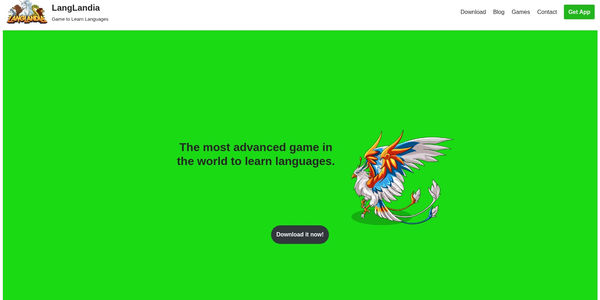
LangLandia is a monster battling game where you trap creatures, grow them, and battle other learners in online PvP arenas. Vocabulary learning happens through flashcard based exercises that trigger during battles, and the competitive structure (clan wars, tournaments, boss battles) provides social pressure to keep studying.
Pricing:
Free core game (all vocabulary accessible through advancement)
Buy Complete Game: $6.99 one time
Fluency Pass: $9.99/mo or $59.99/yr
Fluency Boost Monthly: $21.99
Key features:
1v1 PvP battles, tournaments, clan wars, weekly events, and boss battles
20+ in game storybooks with tap to translate functionality
Hard mode that trains rapid word recognition under pressure
Covers Spanish, French, Japanese, German, Italian, and several other languages
What users say:
One App Store reviewer wrote: "Having tried several apps in my Spanish learning adventure, I feel confident in saying this IS the best. It actually is a game." Another downloaded it as a way to stop doomscrolling and found it "a fun way to keep my brain thinking in Spanish." On the negative side, users have flagged that daily quests sometimes force advancing to new vocabulary areas when they'd prefer reviewing existing words.
Tradeoffs:
Primarily a vocabulary trainer through flashcard mechanics
Monster catching gameplay can feel repetitive for some
Community is smaller than mainstream apps
No spaced repetition system; relies on flashcard review during battles
3. WonderLang

Best for: Desktop gamers who want a full JRPG experience that teaches Spanish.
WonderLang is the only option on this list that lives on PC and Mac rather than mobile. Inspired by Pokémon, Dragon Quest, and Final Fantasy, it's a full RPG where language learning happens through dialogue, quests, and puzzle based combat with spaced repetition baked into the mechanics. If you're a Steam user who wants a learn Spanish app game experience on a bigger screen, this fills a gap no mobile app covers.
Pricing:
Single Language: $24.99 one time (Steam)
Polyglot Version: $38.99 one time (all current and future languages)
Free demo available for the first part of the game
Key features:
45+ hours of combined learning and gameplay
Language taught through in game conversations, quests, and puzzles
Spaced repetition built into combat mechanics
Available in Spanish, French, Portuguese, Italian, German, Korean, Japanese, and Mandarin
Tradeoffs:
PC and Mac only (no mobile version yet, though Android and iOS are planned)
Currently in Steam Early Access, meaning content is still being built
Not suitable for on the go learners who want quick phone sessions
As an Early Access title, expect bugs and incomplete features
Best Niche Spanish Game Apps
Not every learner needs a full RPG. Some people want focused practice on a specific skill: conjugating verbs, unscrambling words, nailing pronunciation, or solving crossword puzzles in Spanish. These smaller, more specialized tools fill gaps that the bigger apps don't prioritize.
1. Conjugato
Best for: Learners who need dedicated verb conjugation drilling in a game format.
Spanish verb conjugation is one of the most common pain points, and mainstream apps tend to teach it passively through sentence exercises rather than drilling it directly. Conjugato takes the opposite approach. It's a focused Spanish conjugation game that quizzes you on verb forms across tenses and moods, tracking your accuracy and speed.
The app presents a verb and tense, and you type or select the correct conjugation. It covers all major tenses (present, preterite, imperfect, future, conditional, subjunctive) and lets you filter by difficulty or tense group. The experience is closer to a timed typing challenge than an RPG, but for learners who specifically struggle with "ser vs. estar" or subjunctive forms, the concentrated practice is valuable.
Practitioners on Reddit frequently recommend Conjugato as a supplement alongside broader tools. One user described it as "the only app that actually made me comfortable with the subjunctive" after months of struggling with it on Duolingo.
Tradeoffs:
Extremely narrow focus (verbs only, no vocabulary or listening)
Game mechanics are minimal (timer, scoring, streaks)
Best used alongside a broader learning tool, never as a standalone
UI is functional but not visually exciting
2. Lingo Arcade
Best for: Crossword and word puzzle enthusiasts who want to practice Spanish through familiar puzzle formats.
Lingo Arcade packages several classic word game formats (crossword puzzles, word searches, unscramble challenges) and applies them to Spanish vocabulary. If you enjoy the New York Times crossword or Wordle and wish those games taught you something useful, this scratches that itch.
The Spanish crossword game mode gives you clues in English and expects answers in Spanish, which forces active recall rather than passive recognition. The word unscramble game mode presents jumbled Spanish letters and asks you to reassemble them, which builds spelling awareness, a skill most flashcard apps completely ignore. There's also a word search mode for lighter practice sessions.
Tradeoffs:
No grammar instruction or sentence building
Vocabulary is limited to what fits puzzle formats
Progression and tracking are basic compared to full learning apps
Works best as a supplement for learners who already have some foundation
3. Polygloss
Best for: Learners focused on Spanish pronunciation practice in a structured format.
Polygloss positions itself as a pronunciation focused learning tool with game like progression. The app uses speech recognition to evaluate your spoken Spanish and provides feedback on accuracy. Exercises build from individual sounds to full phrases, with scoring that creates light competitive motivation.
This fills a real gap. Most learn Spanish app game options focus on reading and vocabulary, not on how words actually sound when you say them. A Spanish pronunciation game that gives real time feedback addresses what is arguably the hardest skill to practice alone. Practitioners on language learning forums note that pronunciation apps vary wildly in speech recognition quality, and Polygloss gets mixed reviews on this front. Some users find the recognition accurate and helpful, while others report frustration with the system misinterpreting correct speech.
Tradeoffs:
Speech recognition accuracy can be inconsistent
Limited vocabulary compared to full learning platforms
Game elements are lightweight (scores and levels, not narrative driven)
Best paired with apps that handle reading and grammar
Spanish Word Games as Skill Builders
Beyond standalone apps, specific game formats target skills that traditional apps overlook. Worth understanding how each format maps to a specific learning outcome:
Spanish crossword games force you to produce a word from a definition or clue, not just recognize it. This active recall is significantly harder than multiple choice and produces stronger memory traces. Several studies on the "testing effect" confirm that effortful retrieval beats passive review for long term retention.
Spanish word unscramble games build orthographic awareness. Spanish spelling is more regular than English, but learners still trip over accent marks, double letters (ll, rr), and silent h. Unscramble exercises force letter by letter attention that no flashcard drill provides. This is particularly helpful as a Spanish spelling game, training you to notice the difference between "año" and "ano" (a distinction that matters quite a lot).
Spanish pronunciation games address the gap between knowing a word on screen and being able to say it intelligibly. Even learners with strong reading skills can mangle pronunciation of words like "desarrollo" or "vergüenza" without targeted practice.
The limitation of all these niche formats is the same: they're narrow. A crossword won't teach you grammar. A pronunciation game won't build reading comprehension. They work best as 10 to 15 minute daily supplements alongside a broader tool that handles vocabulary and grammar systematically. An app like Lingo Legend covers the vocabulary backbone through its RPG and farm gameplay, while niche tools handle the edges.
If you're building your own study routine from scratch, that might look like: 15 minutes of Lingo Legend for vocabulary and grammar recall, 5 minutes of Conjugato for verb drilling, and 5 minutes of a pronunciation tool. That 25 minute daily session covers more ground than an hour of passive flashcard swiping.
Best Gamified Apps to Learn Spanish
These apps use game elements like streaks, XP, and leaderboards to make traditional exercises more engaging. They're not games in the strictest sense, but several are excellent learning tools. If no learn Spanish app game on the market fully meets your needs, a strong gamified app can still be an effective alternative.
1. Clozemaster

Best for: Intermediate learners who want to massively expand Spanish vocabulary through contextual sentences.
Clozemaster sits at the border between game first and gamified drill. It uses fill in the blank (cloze) exercises pulled from a massive sentence database, with gamification through points, leaderboards, and a retro styled interface. It's not a "game" in the traditional sense, but it gamifies sentence level practice more effectively than most alternatives.
Pricing:
Free tier with core gameplay
Pro: approximately €14/month, €97/year, or €327 lifetime
Key features:
Sentence first approach with vocabulary embedded in real context
70+ languages available for English speakers
SRS based review scheduling with detailed metrics
Listening practice mode (Cloze Listening)
What users say:
One testimonial on the site claims: "In one week I've gone from barely understanding Swedish to comprehending most everyday conversations" using the listening feature. Users consistently agree it's best for intermediate and advanced learners, not beginners.
Tradeoffs:
Intentionally minimalist UI (some users call it "sketch looking")
Not suitable for absolute beginners
No speaking practice
More of a gamified drill than a genuine game, despite the point system
2. Duolingo

Best for: Absolute beginners who need a free, zero friction entry point.
Duolingo is the elephant in every language learning room. With roughly 130 million monthly active users, it's the default recommendation for a reason: it works well enough for beginners, costs nothing to start, and the habit building mechanics (streaks, XP, leagues) are genuinely effective at getting people to open the app daily.
Pricing:
Free tier with ads and hearts (genuinely usable long term)
Super Duolingo: $12.99/mo or $83.99/yr
Duolingo Max: $29.99/mo or $167.99/yr (includes AI conversation features)
Student discount: $3.99/mo or $47.99/yr
Key features:
Bite sized lessons designed as mini game style exercises
40+ languages
Massive community and brand recognition
AI powered conversation practice on Max tier
What users say:
Practitioners on Reddit frequently raise the same complaint: Duolingo's gamification has become the product rather than the learning. Users report chasing streaks and XP while retention stagnates. Multiple community discussions note that "Duolingo sentences can be random" and that the gamification becomes the goal itself. This "Duolingo fatigue" is, frankly, one of the main reasons people search for a learn Spanish app game in the first place. For gamers specifically, there's a whole category of fun alternatives to flashcard apps worth exploring.
Tradeoffs:
Not a game in any meaningful sense; it's a quiz app with game wrappers
Exercises get repetitive at higher levels
Free tier hearts limit practice after mistakes
Premium pricing is steep for what amounts to ad removal and unlimited hearts
Gamification can create a feeling of productivity without proportional learning
3. Drops

Best for: Visual learners who want quick, beautiful vocabulary sessions.
Drops focuses entirely on vocabulary through fast paced visual mini games with striking design. Each free session is capped at 5 minutes, which is both a feature (forces focused sprints) and a limitation.
Pricing:
Free: 5 minutes per day per language
Premium: $13/mo, $69.99/yr, or $159.99 lifetime
Key features:
Timed mini games with beautiful illustrations
2,400+ vocabulary items across topics from travel to politics
50+ languages
Swipe based interface designed for one handed phone use
What users say:
Practitioners on Reddit note: "It's the best app I've found so far but only teaches vocabulary." Reviewers generally agree that Drops is a fun supplementary tool but can't function as a primary learning resource since it teaches no grammar at all.
Tradeoffs:
Zero grammar instruction
5 minute free limit is highly restrictive
Won't teach sentence construction
Feels shallow beyond basic vocabulary
4. Memrise

Best for: Learners who want to hear real native speakers, not synthesized audio.
Memrise combines SRS based vocabulary review with native speaker video clips, offering a more authentic listening experience than most competitors. Community created courses add breadth, though quality varies.
Pricing:
Free tier available
Premium: approximately $6 to 7/mo, $59.99/yr, or $179.99 to $329.99 lifetime (varies by promotion)
Key features:
Native speaker video clips for contextual listening
23 languages with official courses
Community made courses covering niche topics
SRS based review scheduling
What users say:
Reddit users specifically value the native speaker videos as more authentic than synthetic audio found in other apps. However, reviewers note Memrise isn't recommended as a standalone tool, calling it "great for memorizing phrases but not as focused on building whole sentences."
Tradeoffs:
Official courses have narrowed in scope over time
Community course quality is inconsistent
Pricing has increased
Not a standalone learning solution
5. Mondly

Best for: Budget conscious casual learners who want short daily sessions.
Mondly, now owned by Pearson, offers daily lessons with conversation drills and some AR/VR features. Its standout quality is price: the annual plan works out to about $4/month, significantly cheaper than nearly every competitor.
Pricing:
Monthly: $10/mo
Annual: $48/yr ($4/mo)
Lifetime: approximately $100 (after frequent discounts)
Key features:
41 languages from a single subscription
AR and VR companion apps
Short daily lessons (roughly 5 minutes each)
Weekly quizzes and monthly challenges
What users say:
Reviewers tend to describe Mondly the same way: "There's nothing bad about Mondly, but there's nothing that really stands out about it either." Multiple reviews note minimal grammar coverage with no dedicated grammar lessons or explanations.
Tradeoffs:
Very shallow learning depth
No grammar instruction
Exercises become repetitive quickly
"Gamification" is surface level (points and streaks, not gameplay)
6. LingoDeer

Best for: Learners who want explicit grammar explanations alongside structured exercises.
LingoDeer takes a grammar forward approach, with each unit beginning with clear grammar breakdowns before moving into varied practice activities. Originally designed for Asian languages, it also covers Spanish.
Pricing:
Approximately $5 to 15/mo depending on region and plan
Lifetime: $59.99
Key features:
Clear grammar explanations at the start of each unit
Varied activities for drilling sentence structure
Speaking and native audio listening exercises at unit end
20 languages
Tradeoffs:
Gamification is more "exercise variety" than actual game
Spanish course may be less polished than the Asian language offerings
Not all language courses are equally thorough
Limited free tier
How to Choose the Right Spanish Game App
The right app depends on what kind of learner you are:
If you're a gamer who wants screen time to feel productive, start with Lingo Legend. The RPG card battler and farm sim modes make it the strongest learn Spanish app game for people who actually play video games.
If you're competitive and motivated by beating other people, LangLandia's PvP battles and clan wars will keep you engaged longer than solo study.
If you're a PC gamer, WonderLang offers a full JRPG experience you won't find on mobile.
If you need verb conjugation help, Conjugato drills tenses more effectively than any general purpose app.
If you love word puzzles, Lingo Arcade's crossword and unscramble modes practice spelling and recall in formats that feel like actual games rather than study sessions.
If you're an intermediate learner who already knows basics and wants to rapidly expand vocabulary, Clozemaster's sentence based approach fills a gap most apps ignore.
If you're a total beginner with zero Spanish knowledge, Duolingo's free tier is still the lowest friction starting point.
If you need grammar, LingoDeer is the only app here that leads with explicit grammar instruction.
If budget is the priority, Mondly's $4/month annual plan is hard to beat.
One crucial piece of advice: combine tools. A game first app like Lingo Legend handles daily vocabulary and grammar recall brilliantly, but it's transparent about not being a full speaking and listening curriculum. Pair it with a conversation tool or tutor for well rounded progress. The developers are open about this, which is refreshing, and you can even submit feature requests directly to the dev team.
Also worth noting: if you want to align your game based practice with a specific class or textbook, Lingo Legend's Custom Curriculum feature lets you import your own word lists via CSV. No other learn Spanish app game on this list offers that level of customization.
For learners who want to start applying their vocabulary to real situations, guides like how to say hello in Spanish or Spanish food vocabulary pair well with game based practice.
FAQ
Can you actually learn Spanish from a game app?
Yes, but with realistic expectations. Game apps are strongest at building vocabulary, training recall, and developing reading comprehension. A 2024 review in Frontiers in Education confirmed that mobile assisted vocabulary learning produces superior retention compared to traditional methods, especially when spaced repetition is involved. What game apps won't do (and honest ones will tell you so) is replace conversation practice, writing composition, or immersive listening. Use them as one piece of a broader study plan.
What's the best free game to learn Spanish?
Duolingo offers the most complete free experience, though it's a gamified drill rather than a true game. For an actual game with a free tier, Lingo Legend lets you play daily with limited energy and optional ads for extra sessions. LangLandia also offers its core game for free, with all vocabulary accessible through progression.
Are game apps better than Duolingo for learning Spanish?
For certain learners, absolutely. If you've tried Duolingo and found yourself chasing streaks without retaining much, a game first Spanish learning app can reignite motivation because the learning is inseparable from gameplay. Duolingo remains better for absolute beginners and people who respond well to streak based habits. The two approaches serve different psychological profiles.
Is there a game app that helps with Spanish verb conjugation?
Conjugato is the most focused option. It drills conjugation across all major tenses and moods with timed challenges and accuracy tracking. Mainstream apps like Duolingo and Lingo Legend teach conjugation within broader exercises, but Conjugato isolates it for concentrated practice. If conjugation is your specific weakness, using Conjugato for 5 to 10 minutes daily alongside a broader tool produces results faster than relying on general purpose apps alone.
Do any Spanish game apps help with pronunciation?
Polygloss focuses specifically on pronunciation with speech recognition feedback. Memrise helps indirectly through native speaker video clips. Most game first apps like Lingo Legend and LangLandia prioritize reading and vocabulary over spoken output. Pronunciation is genuinely hard to practice with an app because speech recognition technology still has significant accuracy limitations, especially with accented or non native speech. A human tutor remains the gold standard for pronunciation correction.
Can I use crossword and word puzzle apps to learn Spanish?
They're helpful supplements but not standalone tools. A Spanish crossword game forces active recall (producing words from clues), which builds stronger memory than passive recognition. Word unscramble games train spelling awareness, which matters more than most learners realize. Both formats are best used for 5 to 10 minutes daily alongside an app that handles structured vocabulary and grammar progression.
How long does it take to learn Spanish with an app?
The FSI estimates roughly 600 classroom hours to reach professional working proficiency in Spanish. No app will replicate that timeline exactly, but consistent daily practice with a game app (15 to 30 minutes per day) can build a strong vocabulary foundation within 3 to 6 months. Pairing app based study with conversation practice, media consumption, and real world use accelerates progress significantly.
Can adults use Spanish learning game apps, or are they for kids?
Every app on this list is designed for adults or older teens. Lingo Legend's RPG card battler and farm sim appeal to the same audience that plays mobile strategy games. LangLandia's PvP system is built for competitive adults. WonderLang is a full JRPG. The childish reputation of "learning games" comes from elementary school software, not from modern game first language apps.
What's the difference between a language game and a gamified language app?
A language game has its own narrative, strategy, and mechanics that you'd enjoy independently. The learning is woven into gameplay (answering questions to power attacks, translating to advance a story). A gamified app adds game like rewards (XP, streaks, badges) to traditional exercises. Both can be effective, but games tend to sustain motivation longer because the engagement comes from the activity itself rather than external reward loops. For more on why that distinction matters psychologically, there's a useful piece on intrinsic motivation in education.
Do any Spanish game apps include spaced repetition?
Yes. Lingo Legend, WonderLang, and Clozemaster all build spaced repetition into their systems, scheduling reviews at optimal intervals so you revisit words right before you'd forget them. This is the single most research backed technique for long term vocabulary retention. LangLandia uses flashcard repetition during battles but doesn't implement a formal SRS algorithm.
Can I use a Spanish game app alongside a textbook or class?
Lingo Legend specifically supports this through its Custom Curriculum feature, which lets you import your own word lists via CSV file. This means you can create decks that match your textbook chapters or classroom assignments. For more tips on integrating game based learning with traditional study, check the Lingo Legend blog.
![Please in German (Bitte): 7 Meanings, Examples [2026]](https://static.wixstatic.com/media/7bc962_4ba7da9021c8414da27ccf0150bba067~mv2.avif/v1/fill/w_600,h_300,al_c,q_80,enc_avif,quality_auto/7bc962_4ba7da9021c8414da27ccf0150bba067~mv2.avif)


Yes, and this is a great topic! Crosswords and word puzzles are one of the best ways to build Spanish vocabulary, because you have to recall the exact spelling instead of just recognizing a word. One detail worth knowing is that Spanish puzzles often include words like año, sueño, and cañón, and the enye counts as its own letter in the alphabet, so it matters in answers. If you're typing a lowercase answer, the enye small page shows how to enter ñ quickly. For puzzles printed or made in capitals, the enye big tool lets you copy Ñ without extra steps. Thanks for the helpful guide!
Great roundup! Testing 12 Spanish learning app games for 2026 saves learners a lot of trial and error, and the game-style picks make daily practice much easier to stick with. One tip for beginners: check how an app handles the Spanish enye, because ñ changes the sound and meaning of words like año (year). It also helps to know the enye small form (ñ) used in everyday words, and the enye big form (Ñ) that appears in capitalized words like ESPAÑA. Thanks for sharing such a practical, well-organized list!
Thanks for putting this list together. I like that you tested each app instead of just listing features, since that's what helps someone pick the right game. While practicing Spanish, many learners get stuck typing answers with accents and special letters. Knowing how to type the enye makes exercises in these apps much smoother. If you want to see how the lowercase letter works in words like niño and mañana, the enye small page explains it clearly. For capital letters in names and headings, a quick enye big copy-paste tool saves time. Looking forward to more posts like this one!