

Best Duolingo Alternative for Japanese: 10 Picks (2026)


TL;DR
Duolingo’s Japanese course caps out around JLPT N5, teaches grammar implicitly (which fails for Japanese), and now limits free users with an energy system. The best Duolingo alternatives for Japanese depend on your goal: Lingo Legend for gamers who want real RPG gameplay with vocab and stroke-order practice, LingoDeer for structured grammar lessons, WaniKani for kanji mastery, and Bunpro for JLPT-aligned grammar drilling. Most serious learners stack two or three apps together rather than relying on a single tool.
Why Learners Are Leaving Duolingo for Japanese
If you searched for the best Duolingo alternative for Japanese, you probably already know something feels off about the course. You’re not imagining it.
Japanese is one of the hardest languages for English speakers, with the FSI estimating roughly 2,200 class hours to reach proficiency. It uses three writing systems (hiragana, katakana, and kanji), complex particle grammar, and multiple politeness levels. Duolingo’s approach of teaching grammar implicitly, hoping you’ll absorb rules through repetition, works passably for Spanish or French. For Japanese, reviewers have found this method “fails hard” because the sentence structures are so different from English that learners can’t intuit the patterns.
Then there’s the kanji problem. Duolingo introduces kanji inconsistently. You might see 食べる written in kanji in one exercise and hiragana the next, with no explanation of how readings work or why. The course covers roughly 2,000 words total, which puts it at about JLPT N5 level, the very bottom rung. Everyday Japanese literacy requires around 2,000 kanji alone.
The monetization situation has made things worse. Duolingo’s new Energy system, which began rolling out in mid-2025, limits free users to 25 energy units per day, and you lose units even on correct answers. The backlash was severe enough that Duolingo’s stock dropped roughly 30% as users revolted against increased ads and aggressive subscription pressure. With 130 million monthly active users but only 9.5 million paid subscribers, the vast majority of learners are on the restricted free tier, exactly the group looking for alternatives.
Practitioners on Reddit’s r/LearnJapanese community have noted additional problems: inaccurate translations that lead learners to memorize wrong language, essentially nonexistent speaking practice, and a pace that many find painfully slow.
The bottom line: Duolingo can spark initial interest in Japanese, but it wasn’t built for the language’s unique demands. What follows are 10 alternatives that were.
Quick Comparison Table
The 10 Best Duolingo Alternatives for Japanese
1. Lingo Legend

Best for: Gamers who need real gameplay to stay motivated
Most language apps call themselves “gamified” because they added points and streaks. Lingo Legend is different. It’s a full RPG card-battler combined with a cozy farm sim, with language learning embedded directly into the gameplay loop rather than bolted on as an afterthought. One LingoPie comparison described it as “an actual RPG, not just lessons with game elements slapped on.”
For Japanese specifically, this matters. The app includes tracing and stroke-order exercises for kana and kanji, something most mainstream alternatives skip entirely. It also supports a Custom Curriculum feature where you can import your own study material via CSV, so if you’re following Genki or Minna no Nihongo, you can align your in-game practice with your textbook. No competing article in the top search results even mentions this capability, but it solves a real problem for intermediate learners.
Key features:
Two game modes: Adventure Mode (strategic RPG combat) and Farm Mode (relaxed vocabulary practice), both connected in one world. You can explore the Yorthwood game world to see what this looks like.
3,500+ words and phrases across 150+ categories with spaced repetition built in
Multiple quiz types: multiple choice, spelling, true/false, tracing
Study multiple languages (10 available, including Japanese) without losing progress when switching
Monthly challenges, leaderboards, badges, and guild system
Active community on Discord and Reddit with regular dev AMAs
Pricing: Free to download with limited daily energy and optional rewarded ads. Subscriptions: $9.99/month, $44.99/6 months, $69.99/year, or $129.99 lifetime. Download Lingo Legend here.
User perspective: A Medium reviewer who completed all quests noted that for Japanese, the app lets users “trace the kana/kanji at least once” and praised the story-mode structure with customizable decks. The same reviewer noted the primary focus is recognition and recall rather than writing production, suggesting pairing it with a dedicated writing tool.
Tradeoffs:
Not a full speaking or listening curriculum. You’ll still need other tools for conversation practice.
Free tier has limited daily energy (though no aggressive microtransactions)
English-only UI
10 languages, intentionally focused rather than expansive
Who should pick this: Learners who quit Duolingo because it was boring. People who play mobile games anyway and want that time to count toward learning. Anyone studying multiple languages who wants one app that handles them all. The 4.9/5 App Store rating from roughly 4,100 ratings and its PocketGamer.biz Mobile Game of the Week recognition suggest it delivers on the gameplay promise.
2. LingoDeer

Best for: Absolute beginners wanting structured Japanese lessons with real grammar explanations
LingoDeer is the most-recommended Duolingo replacement for Japanese on Reddit, and it’s easy to see why. Unlike Duolingo, LingoDeer was specifically designed for Asian languages, not retrofitted for them. The difference shows immediately in how it handles particles, verb conjugations, and sentence structure.
Where Duolingo expects you to figure out grammar through exposure, LingoDeer provides explicit explanations that actually make sense. One reviewer at Japademy put it bluntly: “It’s the app that language learners point to when Duolingo’s Japanese course disappoints them, and for good reason.”
Key features:
Clear grammar breakdowns with particles, verb forms, and sentence structures
Content covering JLPT N5 through approximately N3
Native speaker audio with pronunciation feedback
Structured lesson progression designed for Asian language learners
Available on iOS, Android, and web
Pricing: $12.99/month for one language, $32.99 for 3 months, $76.99/year, or $119.99 lifetime. Trial available but no permanent free tier.
Tradeoffs:
Caps out at intermediate level, so advanced learners will need to move on
More expensive than Duolingo’s free tier
Gamification exists but it’s nothing like an actual game
Primarily a beginner tool
Who should pick this: Someone who just started (or recently finished) Duolingo’s Japanese course and wants to continue with a similar format but dramatically better grammar instruction. If you need the best structured course as a Duolingo alternative for Japanese, this is probably it.
3. WaniKani

Best for: Systematic kanji mastery through mnemonics and SRS
Kanji is the wall that stops most Japanese learners cold. WaniKani exists to demolish that wall. It teaches 2,000 kanji and over 6,000 vocabulary words through a mnemonic system paired with spaced repetition, and it does this one thing better than almost any other tool available.
The r/LearnJapanese community treats WaniKani with something approaching reverence. JLPT Samurai, summarizing the Reddit consensus, calls it a “paid cult that works,” which captures the reality: the locked progression pace frustrates some learners, but the results speak for themselves.
Key features:
Mnemonic stories for every kanji and vocabulary item
SRS scheduling that adapts to your recall accuracy
Locked progression (must demonstrate mastery before advancing)
Community forums with active discussions
First 3 levels free to test the system
Pricing: $9/month, $89/year, or $299 lifetime. First 3 levels free.
User perspective: One reviewer acknowledged that “if you can look past the UI deficiencies, it’s an otherwise great product for Japanese at a perfectly reasonable price point.” The interface looks dated but the system underneath is solid.
Tradeoffs:
Assumes you already know hiragana and katakana
Very slow early pace (by design, but frustrating for eager learners)
No grammar, speaking, or listening practice at all
Web-only, no native mobile app
Does one thing, ignores everything else
Who should pick this: Intermediate learners who can read kana but keep hitting the kanji wall. If you’re past the absolute beginner stage and recognize that kanji knowledge is your bottleneck, WaniKani is the gold standard.
4. Bunpro
Best for: JLPT-aligned grammar drilling with active recall
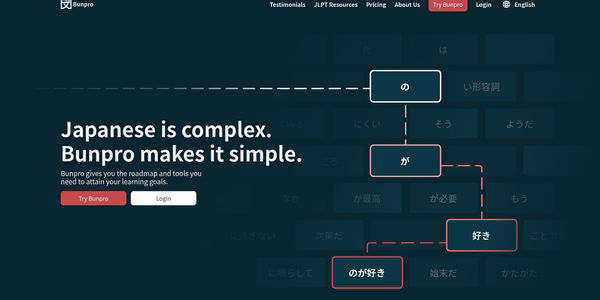
If WaniKani is the kanji specialist, Bunpro is the grammar specialist. It covers 900+ grammar points organized by JLPT level from N5 through N1, with over 10,000 example sentences. The system forces you to type your answers rather than tap multiple choice, which is significantly more effective for retention.
At $5/month, Bunpro is one of the most affordable dedicated tools for Japanese grammar and one of the best Duolingo alternatives for Japanese learners who specifically struggle with particles, verb forms, and sentence patterns.
Key features:
Grammar points organized by JLPT level (N5 to N1)
Active recall through typed cloze-deletion exercises
Links to external grammar resources for deeper explanations
SRS scheduling for review
30-day free trial, no credit card required
Pricing: $5/month, $55/year, or $150 lifetime. The 30-day free trial is genuinely generous.
User perspective: JLPTLord’s review warns that “cloze drills can feel repetitive, the review pile grows heavy at advanced levels,” with some learners reporting 100+ reviews per day. This is a real consideration if you add lots of grammar points quickly.
Tradeoffs:
Doesn’t teach writing systems at all (assumes you can read kana)
Review pile management becomes a chore if you’re not disciplined
No vocabulary focus beyond grammar examples
Not beginner-friendly without prior kana knowledge
Dry compared to gamified options
Who should pick this: Post-beginner learners preparing for JLPT who want structured, systematic grammar practice. Pairs especially well with WaniKani (kanji) and a vocab tool.
5. Anki

Best for: Self-directed learners who want total control and a free option
Anki is the power tool of the Japanese learning community. It’s an open-source spaced repetition flashcard system that’s free on desktop and Android (the iOS app costs $25 as a one-time purchase). The r/LearnJapanese subreddit treats it as almost mandatory, and thousands of pre-made Japanese decks exist: Core 2k/6k/10k vocabulary, JLPT-level kanji sets, sentence mining decks, and more.
The catch is that Anki is not user-friendly. Tofugu’s review acknowledged that even experienced learners find themselves “frustrated by its myriad options and at-times dogmatic” interface. Setup takes time. But once configured, nothing matches its flexibility.
Key features:
Unlimited customization: add audio, images, furigana, example sentences
Thousands of community-created Japanese decks
Available on Windows, Mac, Linux, Android (free), and iOS ($25)
Sync across devices via AnkiWeb
Complete control over card intervals, design, and study parameters
Pricing: Free on desktop and Android. $25 one-time on iOS. No subscriptions.
Tradeoffs:
Steep learning curve for setup and configuration
Dated interface that hasn’t aged well
No guided curriculum, lessons, or structure
Requires self-discipline to create and maintain decks
Not fun. At all.
Who should pick this: Budget-conscious learners willing to invest setup time. People following textbooks who want to create custom flashcards. Anyone who values control over convenience. If you want a free alternative to Duolingo for Japanese and have the patience for it, Anki is unbeatable.
For learners who want the custom deck functionality but wrapped in actual gameplay, Lingo Legend’s CSV import feature lets you import your own study material into RPG and farm-sim modes.
6. Pimsleur

Best for: Speaking and listening practice, especially for commuters
Pimsleur takes a completely different approach from everything else on this list. It’s pure audio, delivered in 30-minute lessons focused on conversation and pronunciation. You listen, repeat, and gradually build up spoken fluency through a graduated interval recall method.
For Japanese, this approach has real merit. As Migaku’s comparison notes, “You’ll develop decent pronunciation because you’re mimicking native speakers constantly.” The speaking gap is one of Duolingo’s biggest weaknesses for Japanese, and Pimsleur fills it directly.
Key features:
Audio-first methodology with 30-minute structured lessons
Graduated interval recall for long-term retention
Native speaker models for pronunciation
Available in 50+ languages
7-day free trial
Pricing: $14.95/month to $19.95/month depending on plan. More expensive than most app alternatives.
Tradeoffs:
Cannot learn kanji or any writing through audio
No reading or writing component whatsoever
30-minute lessons are long compared to 5-minute app sessions
Expensive relative to competitors
Conversational vocabulary only, no JLPT alignment
Who should pick this: Commuters, auditory learners, and anyone preparing for actual conversations in Japan. Best used alongside a reading/writing tool rather than as a standalone solution.

Best for: Bridging the gap between textbook Japanese and real Japanese text
There’s a painful stage in Japanese learning where you’ve finished your beginner materials but can’t read anything real. Satori Reader was built for exactly this moment. It provides original stories written at various difficulty levels, with context-aware translations, grammar notes, and native speaker audio for every sentence.
Key features:
Story-based reading content with new material added weekly
Context-aware dictionary that adjusts definitions based on the sentence
Built-in SRS review system
Grammar explanations tied to what you’re actually reading
Adjustable difficulty settings
Pricing: $9/month or $89/year. Free trial available.
Tradeoffs:
Not for absolute beginners (requires basic reading ability)
No speaking practice
Supplementary tool only, not a standalone course
Limited to reading skill development
Who should pick this: Post-beginner learners (roughly JLPT N4+) who want to develop reading fluency with material that’s actually interesting. A strong component of any intermediate Japanese app stack.
8. Memrise

Best for: Native-speaker video clips and vocabulary exposure
Memrise’s main draw is video clips of real native speakers using vocabulary in context. For Japanese, this provides exposure to natural speech patterns, intonation, and real-world usage that most text-based apps miss.
Key features:
Video clips with native Japanese speakers
SRS-based vocabulary drilling
Community-created courses available
Courses in 20+ languages
Available on iOS, Android, and web
Pricing: Approximately $14.99/month, $59.99/year, or $179.99 lifetime. Limited free tier available.
User perspective: Practitioners on forums note that Memrise’s Japanese course quality is weaker than its European language courses. Some find it useful as a supplement but not reliable as a primary tool.
Tradeoffs:
Japanese content quality lags behind European languages
Many features locked behind paywall
Limited writing practice
Not structured enough to serve as a primary learning resource
Vocabulary-heavy with little grammar instruction
Who should pick this: Learners wanting supplementary vocabulary exposure with native-speaker video. Not a standalone alternative to Duolingo for Japanese, but useful in a broader stack.
9. Clozemaster

Best for: Expanding vocabulary through real sentence context
Clozemaster takes a simple idea (fill in the blank within real sentences) and runs with it. The cloze-deletion format forces you to understand vocabulary within context rather than in isolation, which builds contextual understanding that isolated flashcards don’t provide. It has a retro arcade aesthetic with points and leaderboards for light competition.
Key features:
Cloze-deletion exercises using real sentences
Massive sentence database across many languages
Points, leaderboards, and tracking
Free version with substantial content
Premium available for additional features
Pricing: Generous free tier. Premium subscription available for extras.
Tradeoffs:
Not for beginners (assumes existing vocabulary and reading ability)
Niche UI that won’t appeal to everyone
No writing system instruction
Minimal grammar explanation
Supplementary tool, not a primary course
Who should pick this: Intermediate to advanced learners who want to expand vocabulary through contextual exposure rather than isolated flashcards.
10. KanaDojo
Best for: Free, no-strings-attached kana and kanji drilling
Sometimes you just need a clean, free tool to drill writing systems without ads, paywalls, or distractions. KanaDojo is exactly that. It covers hiragana, katakana, 2,000+ JLPT kanji, and thousands of vocabulary words organized by JLPT level, all completely free.
Key features:
Completely free, no ads, no paywall
Hiragana, katakana, and JLPT-organized kanji (N5 to N1)
6 practice modes with 100+ themes
Web-based progressive web app (works on any device)
JLPT-level organization for test prep
Pricing: Free. Entirely.
Tradeoffs:
No grammar instruction
No speaking or listening practice
Community-made, so less polished than commercial apps
Limited to recognition drilling, not a full learning system
Who should pick this: Absolute beginners mastering kana, or any learner wanting free JLPT kanji recognition practice. A zero-risk addition to any study stack.
How to Build Your Japanese App Stack
Here’s something the Reddit community understands that most “best app” articles miss: no single app will teach you Japanese. The most successful learners stack tools, picking one for each core skill.
Analysis of r/LearnJapanese recommendations shows a clear pattern. The community’s most-suggested beginner combination is WaniKani for kanji, Bunpro for grammar, and Anki or a gamified alternative for vocabulary. Intermediate learners typically add Satori Reader for reading practice and YouTube or podcasts for listening.
Beginner Stack (Just Starting Out)
Vocabulary and motivation:Lingo Legend (gamified vocab with stroke-order practice for kana and kanji)
Grammar: LingoDeer (structured lessons designed for Japanese)
Kana drilling: KanaDojo (free, focused, no distractions)
This stack covers writing systems, vocabulary, and grammar while keeping things engaging. If you’re also learning Mandarin Chinese or Korean, Lingo Legend lets you switch between languages without losing progress in any of them.
Post-Duolingo Intermediate Stack
Kanji: WaniKani (systematic, mnemonic-driven)
Grammar: Bunpro (JLPT-aligned, active recall)
Vocabulary + fun: Lingo Legend or Anki (depending on whether you prefer gameplay or total control)
Reading: Satori Reader (bridging textbook to real text)
Speaking: Pimsleur (audio-focused conversation practice)
Budget Stack (Mostly Free)
Vocabulary: Anki (free on desktop and Android)
Grammar: Bunpro’s 30-day trial, then Tae Kim’s Grammar Guide (free online resource)
Kanji: WaniKani’s first 3 free levels, then KanaDojo
Reading: NHK Web Easy (free graded news articles)
The point isn’t to use every tool on this list. It’s to pick one app per skill area and commit. Even two well-chosen tools will outperform Duolingo alone for Japanese.
Frequently Asked Questions
Is Duolingo actually bad for Japanese?
It’s not terrible as a first taste. The gamification can get absolute beginners through hiragana and basic vocabulary, and that has real value. But the implicit grammar approach doesn’t work well for a language this structurally different from English, the kanji instruction is disorganized, and the course caps out at roughly JLPT N5 level. For anyone serious about Japanese, you’ll need to move beyond it.
Can one app completely replace Duolingo for Japanese?
LingoDeer comes closest to a direct replacement because it has a similar lesson-based structure with dramatically better grammar instruction. But Japanese has so many distinct skill areas (kanji, grammar, speaking, reading, writing systems) that stacking two or three focused tools typically produces better results than relying on any single app.
What JLPT level can I reach with apps alone?
Most app-based learners can comfortably reach N4, and dedicated users who stack tools effectively can push into N3 territory. Beyond that, you’ll likely need textbooks, native content consumption, and conversation practice with real people. For reference, JLPT has five levels from N5 (easiest) to N1 (hardest), and everyday literacy requires approximately 2,000 kanji.
Is it worth paying for a Japanese learning app?
Yes, with caveats. Free tools like Anki and KanaDojo are genuinely excellent, but they require more self-direction. Paid apps like Bunpro ($5/month), WaniKani ($9/month), and Lingo Legend ($9.99/month) provide structure, motivation systems, and curated content that save significant time. The lifetime deals on most platforms make the long-term cost reasonable given that Japanese takes years to learn.
Do I need to learn stroke order for kanji?
Stroke order matters more than many English speakers assume. It affects how characters look when handwritten (and increasingly, how handwriting recognition works on phones). It also helps with memorization because consistent stroke patterns create muscle memory. Tools that include tracing practice, like Lingo Legend’s stroke-order exercises, give you an advantage that pure flashcard apps don’t.
What’s the best free Duolingo alternative for Japanese?
Anki is the most powerful free option, though it requires significant setup time. KanaDojo is the best free tool for writing system practice specifically. Clozemaster offers generous free content for intermediate vocabulary building. If you want something free with actual gameplay, Lingo Legend’s free tier provides daily sessions with optional rewarded ads for extra energy. For the best results, combine two or three free tools.
How long does it take to learn Japanese with apps?
The FSI estimates about 2,200 class hours for English speakers to reach professional proficiency in Japanese. Apps alone won’t get you there, but they can efficiently build the vocabulary, kanji recognition, and grammar knowledge that forms the foundation. Consistent daily practice with well-chosen tools can reach basic conversational ability (roughly N4) within 12 to 18 months, though individual results vary widely.
Should I still use Duolingo alongside other Japanese apps?
If you genuinely enjoy Duolingo and it keeps you coming back daily, there’s no harm in keeping it as a warm-up or review tool. The problem is when it’s your only tool. Pairing Duolingo with something that teaches grammar explicitly (LingoDeer or Bunpro) and something that handles kanji systematically (WaniKani or Lingo Legend) will produce dramatically better results than Duolingo alone.
If you have suggestions for tools we missed or want to share your own experience with Japanese learning apps, the Lingo Legend team actively reads community input. You can share your feedback directly with the developers or visit the blog for more language learning tips.
![Please in German (Bitte): 7 Meanings, Examples [2026]](https://static.wixstatic.com/media/7bc962_4ba7da9021c8414da27ccf0150bba067~mv2.avif/v1/fill/w_600,h_300,al_c,q_80,enc_avif,quality_auto/7bc962_4ba7da9021c8414da27ccf0150bba067~mv2.avif)


Comments