

Best Duolingo Alternative for German in 2026: 8 Apps
- Chad Morris

- 4 days ago
- 11 min read

TL;DR
German’s case system, gendered nouns, and word order rules demand more than Duolingo’s tap-and-match drills. The best Duolingo alternative for German depends on your learning style: Lingo Legend for gamers who need motivation, Babbel for structured grammar courses, Nicos Weg for a completely free German-specific program, and Clozemaster for intermediate learners building vocabulary in context. No single app creates fluency, so stacking two or three tools gives the best results.
Quick Comparison Table
Why German Learners Specifically Outgrow Duolingo
Duolingo has 37.2 million daily active users and works reasonably well for languages like Spanish and French, where word order mirrors English and grammar rules are comparatively forgiving. German is a different animal.
German has four grammatical cases (nominative, accusative, dative, genitive) that change the articles, adjectives, and sometimes nouns depending on a word’s role in the sentence. Every noun has one of three genders, and you just have to memorize them. Separable verbs split apart and send half the word to the end of the clause. Subordinate clauses rearrange everything. None of this is intuitive, and none of it can be learned through pattern matching alone.
Duolingo’s exercise format, tapping tiles and matching pictures, doesn’t explain why “dem Mann” is correct but “den Mann” is wrong in a particular sentence. It expects you to absorb grammar rules by osmosis.
Practitioners on Reddit’s r/German subreddit describe this wall clearly. The top-ranking thread for this query includes a learner who maintained a long streak but concluded: “I can’t write or speak German well. Reading and grammar are doing okay.” The frustration isn’t that Duolingo teaches nothing. It’s that Duolingo alone leaves German learners unable to produce the language.
The backlash extends beyond German-specific forums. Class Central reported that learners on r/Duolingo have been breaking multi-year streaks and canceling subscriptions, with subreddit moderators contacting CEO Luis von Ahn directly with user concerns. The hearts system, which punishes mistakes by limiting practice, is especially counterproductive for German, where experimentation with case endings is how you learn.
Streaks measure consistency, not competence. If you’re searching for the best Duolingo alternative for German, you probably already know this. Understanding why motivation systems fail on their own is the first step toward choosing something better.
Let’s look at what actually works.
The 8 Best Duolingo Alternatives for German
1. Lingo Legend

Best for: Gamers, ADHD learners, and anyone who’s burned out on drill apps
Disclosure: We built Lingo Legend. We’ll be honest about what it does and doesn’t do.
Lingo Legend is a mobile language-learning game built by indie studio Hyperthought Games. It’s not a language app with game-like decorations. It’s an actual RPG card-battler and farm simulator with language exercises woven into the gameplay. You build decks, battle enemies, grow crops, and learn German vocabulary and phrases through the mechanics themselves.
Pricing:
Free to download with limited daily play (energy system, optional ads for extra energy)
1 Month: $9.99
6 Months: $44.99
12 Months: $69.99
Lifetime: $129.99
Not sure how app subscriptions work? Here’s a glossary of subscription terms that explains everything.
What’s great for German:
3,500+ words and phrases across 150+ categories, with German as a fully supported language
Spaced repetition scheduling means vocabulary reviews happen at optimal intervals for retention
Word-builder exercises force active recall, not just recognition, which matters for German spelling and compound words
Custom Curriculum lets you import CSV decks to align with a German textbook or class
Monthly challenges, leaderboards, guilds, and an active Discord community provide accountability beyond streaks
Switch between German and any of the other 9 supported languages without losing progress
What’s missing:
Not a full course for speaking or listening mastery. You’ll still need conversation practice from another source.
Free tier limits daily play through an energy system
English-only UI
10 languages available (depth over breadth)
Real user context: Lingo Legend holds a 4.9/5 average from approximately 4,100 ratings on the Apple App Store. PocketGamer.biz named it Mobile Game of the Week in March 2022. The developers are active on Reddit and Discord, running AMAs and shipping frequent updates based on community feedback.
The difference between gamified apps and real games matters here. Duolingo adds game-like wrappers (streaks, gems, leagues) to what is essentially a drill app. Lingo Legend is a game you’d play anyway, with language learning built into its core loop. For German learners who quit apps out of boredom, that distinction is everything.
2. Babbel

Best for: Structured, self-paced grammar learning from day one
Babbel is a German company, and German was its first language offering. That heritage shows. The German course is one of the most thorough in Babbel’s catalog, with roughly 225 hours of material across about 15 levels, including topic-based courses for business German and cultural modules.
Pricing:
MSRP is $18/month, but promotions are nearly constant
~$15/mo for 3 months, ~$13/mo for 6 months, ~$8/mo for 12 months
Lifetime subscription sometimes discounted to $200-$300
20-day money-back guarantee on all subscriptions
What’s great for German:
Grammar explanations are built into lessons, not hidden in tips. Cases, gender, and word order get proper treatment.
AI-powered Conversation Partner feature is now available for German
Lessons are structured around real conversations (ordering food, giving directions) rather than isolated vocabulary
Being built by native German speakers gives the content an authenticity you can feel
What’s missing:
Speaking exercises lack depth compared to dedicated tutoring apps
Less helpful once you reach intermediate level; the ceiling is lower than some alternatives
Each language requires a separate subscription (unless you buy lifetime access), so you can’t switch between German and French
Real user context: Babbel maintains a 4.7/5 rating across the App Store, Google Play, and Trustpilot. Users consistently praise its clear grammar guidance, which is exactly what German learners need.
If you want the closest thing to a traditional German course in app form, Babbel is the strongest pick. It’s the best Duolingo alternative for German learners who want structure over gamification.

Best for: Self-study learners who want a complete, free German course
Nicos Weg is produced by Deutsche Welle, Germany’s international broadcaster, and it’s completely free. The course follows Nico, a young Spaniard navigating life in Germany, through video episodes paired with exercises. It covers A1 through B1 on the CEFR scale.
Pricing:
100% free. No premium tier, no energy limits, no ads.
What’s great for German:
Purpose-built for German, not adapted from a multi-language template
Grammar points emerge naturally from video storylines, then get reinforced with clear explanations
Covers practical situations (apartments, doctors, jobs) that matter for people actually living in Germany
Production quality rivals paid apps
What’s missing:
No speech recognition or interactive speaking exercises beyond basic repetition
Not a mobile-first experience; works better on desktop
No spaced repetition system built in, so you’ll need a separate tool for vocabulary review
Stops at B1; advanced learners need to look elsewhere
Real user context: Nicos Weg is arguably the single most recommended free German resource across Reddit and language learning forums. One widely cited assessment from Clozemaster’s blog states it “rivals and often surpasses many paid resources.” Users on r/German regularly recommend it as a first step before investing in paid apps.
If someone asks “Is there a completely free Duolingo alternative for German?”, the answer is Nicos Weg.
4. Memrise
Best for: Learning German from native speaker videos and audio
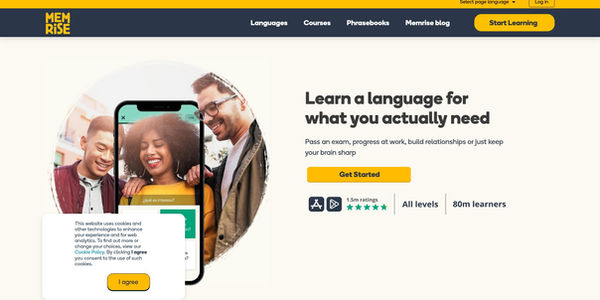
Memrise built its reputation on user-generated flashcard courses, but it has since pivoted to a structured curriculum with heavy emphasis on native speaker video clips. The German course spans 31 levels from Absolute Beginner to Master, and the videos give you exposure to real accents and speech patterns that other apps simply can’t replicate.
Pricing:
Free plan with core lesson access
Premium: $14.99/month or $89.99/year
Lifetime: $329.99
What’s great for German:
Native speaker videos help train your ear for natural German pronunciation and cadence
AI-powered “Pro Chats” let you practice conversation with a language partner
Spaced repetition is baked into the review system
31 levels provide decent depth for the price
What’s missing:
No grammar lessons at all. If dative case is your weak spot, Memrise won’t explain it.
Primarily a vocabulary tool; doesn’t teach sentence construction
Removed user-generated courses from the main platform, which significantly limited content scope
Free version starts repeating content quickly
Real user context: G2 reviewers describe the interface as “interactive and engaging,” with one noting Memrise helped them “learn basic German in just a few months.” It’s strong as an immersion supplement, weak as a standalone German learning tool.
5. LingoDeer

Best for: Thorough grammar instruction that Duolingo skips
LingoDeer originally focused on Asian languages (Japanese, Korean, Chinese), where grammar structure differs wildly from English and requires explicit explanation. That grammar-first philosophy carries over to its German course, making it one of the better Duolingo alternatives for German grammar specifically.
Pricing:
$12.99/month
$32.99 for 3 months
$76.99/year
$119.99 lifetime (one language)
Multilingual pass: $6.66-$13.99/month
What’s great for German:
Detailed “Learning Tips” sections explain grammar rules before exercises begin
HD native speaker audio for pronunciation
Exercises build progressively from recognition to production
Covers German cases and word order more explicitly than Duolingo
What’s missing:
Won’t get you conversational on its own; speaking practice is limited
Lacks authentic video content or cultural immersion material
Some courses feel less thorough than the flagship Asian language offerings
Smaller user community than Babbel or Memrise
Real user context: A German teacher reviewing LingoDeer on YourDailyGerman wrote that it “has all the good things of Duolingo, and some of the things that people miss on Duolingo. Particularly, proper grammar explanations and actual progress.” G2 reviewers note that LingoDeer “is more structured with the language lessons” and that “the notifications are not as annoying as Duolingo.”
That first point matters. When a native German teacher says an app teaches grammar better than Duolingo, German learners should pay attention.
6. Busuu

Best for: CEFR-aligned progress with feedback from native speakers
Busuu structures its courses around CEFR levels and has a partnership with McGraw-Hill Education for official certificates. Its standout feature is the community correction system: you submit written or spoken exercises, and native German speakers review them, often within minutes.
Pricing:
Free version (very limited)
Premium plans are subscription-based
One-on-one tutoring: $11.78 to $15.32 per lesson
7-day free trial on 6 or 12-month plans, plus a 14-day money-back guarantee
What’s great for German:
Courses mapped to CEFR levels (A1 through B2) give you measurable milestones
Community feedback from native speakers catches errors a machine might miss
AI-powered speaking section for conversation practice
German is one of Busuu’s strongest courses
What’s missing:
Free version is too thin to be useful beyond a test run
Less addictive than Duolingo or game-based alternatives; some learners struggle to stay consistent
Previously offered live tutor lessons but discontinued that feature
Smaller content library than Babbel for German specifically
Real user context: Practitioners on Reddit often recommend Busuu for intermediate German learners who already have basic grammar and need production practice. The human feedback loop is its killer feature, something no algorithm fully replaces.
7. Clozemaster

Best for: Intermediate and advanced learners building vocabulary through real sentences
Clozemaster uses cloze-deletion exercises, fill-in-the-blank with real sentences from the Tatoeba database, to teach vocabulary in context rather than in isolation. Its Fluency Fast Track presents words by frequency, so you learn the most common German words first and gradually work toward rarer vocabulary.
Pricing:
Free version with limited content
$12.99/month, $69.99/year, or $199.99 lifetime
What’s great for German:
Learning words inside sentences means you absorb case usage, prepositions, and word order naturally
Frequency-based ordering is efficient for building comprehension quickly
Built-in spaced repetition for long-term retention
Massive German sentence library
What’s missing:
Requires at least intermediate German knowledge; absolute beginners will be lost
Retro, no-frills interface that looks cluttered and can feel overwhelming
No speaking practice whatsoever
No grammar explanations, just exposure through context
Real user context: On Clozemaster’s own forums, a one-year German user called it “a solid replacement for Duolingo for daily vocabulary practice.” The key distinction is that Clozemaster picks up where Duolingo drops off. It’s not a beginner tool; it’s a sharpening tool.
8. Drops

Best for: Quick visual vocabulary sessions as a supplement
Drops is a swipe-based vocabulary app with illustrated word associations across 180+ topics. The free version gives you five minutes of learning per day, which sounds limiting but forces focused micro-sessions.
Pricing:
Free base program (5-minute daily sessions)
Premium: $13/month, $69.99/year, or $159.99 lifetime
What’s great for German:
Beautiful visual design makes vocabulary stick through image association
180+ topical categories (food, sports, travel, art) cover practical ground
Perfect for bus rides, waiting rooms, or coffee breaks
45 languages available if you’re learning more than just German
What’s missing:
Only teaches vocabulary, not grammar. For German, this is a critical gap since you won’t learn grammatical gender or case usage.
Free plan caps at 5-10 minutes per day
No sentence construction, no reading practice, no listening comprehension
Some illustrations are ambiguous enough to cause confusion
Real user context: One Google Play reviewer noted “having iffy single color pictures that could represent one of a million words or phrases,” finding the method sometimes unreliable. Drops works best as a supplement alongside a grammar-focused tool, not as a standalone German learning app.
How to Stack These Tools for Real German Progress
No single app will make you fluent in German. The learners making real progress on Reddit’s r/German forum almost universally describe using two or three tools in combination. Here’s how to think about stacking.
The framework: Pick one core study tool (grammar + structure), one vocabulary retention layer (daily practice), and eventually add speaking practice.
Stack for beginners:
Core: Babbel or Nicos Weg for grammar foundations
Vocab retention: Lingo Legend for daily engagement through gameplay
Speaking: italki or Tandem once you reach A2
Stack for gamers and ADHD learners:
Core + vocab: Lingo Legend as daily driver (German course with spaced repetition built in)
Grammar reference: LingoDeer for explicit grammar lessons when you hit a wall
Speaking: Language exchange apps when ready
Stack for busy professionals:
Core: Busuu (CEFR progress tracking, certificates for employers)
Vocab snacks: Drops for 5-minute sessions on the commute
Deep review: Clozemaster for intermediate vocabulary building
Stack for intermediate learners hitting a plateau:
Core: Clozemaster for frequency-based vocabulary in context
Grammar review: LingoDeer for targeted case and word order practice
Immersion: Memrise for native speaker video exposure
The key insight from the German learning community is that Duolingo’s failure isn’t gamification itself. It’s that Duolingo treats German the same way it treats Spanish, and those languages have fundamentally different learning challenges. The best Duolingo alternative for German is usually a combination of tools that address grammar explanation, vocabulary retention, and active production separately.
If you want to make the vocabulary retention part feel like something other than flashcards, that’s where a game-based approach shines.
FAQ
Is there a completely free Duolingo alternative for German?
Yes. Nicos Weg by Deutsche Welle is 100% free, covers A1 through B1, and is purpose-built for German learners. It’s the most recommended free German resource across Reddit and language learning forums. Lingo Legend also offers a free tier with limited daily play.
Which app teaches German grammar best?
Babbel and LingoDeer both provide explicit grammar explanations that Duolingo lacks. Babbel is stronger for beginners who want a full course structure. LingoDeer is better if you specifically want detailed grammar tips before each exercise. A German teacher on YourDailyGerman described LingoDeer as “what Duolingo could be if they took the idea of teaching someone a language seriously.”
What’s the best German learning app for gamers?
Lingo Legend is built as an actual RPG card-battler and farm simulator with language learning embedded in the gameplay. Unlike Duolingo’s gamified wrappers (streaks, gems), Lingo Legend is a real game with strategy, collectible cards, and quests. It supports German along with 9 other languages.
Can I learn German and another language in one app?
Several apps support this. Lingo Legend lets you study multiple languages on one account without losing progress when switching. Memrise and Drops also support multiple languages, though Drops doesn’t track cross-language progress as seamlessly.
Why is Duolingo bad for German specifically?
German’s four grammatical cases, three genders, separable verbs, and subordinate clause word order all require explicit explanation. Duolingo’s tap-and-match format expects you to infer these rules through pattern recognition, which works for simpler grammar systems but falls short for German. The hearts system also punishes the kind of trial-and-error that German grammar demands.
Is Babbel worth it for German?
For beginners through low-intermediate learners, Babbel is one of the strongest options. It was founded as a German company with German as its first language, and the course includes roughly 225 hours of material. At around $8/month on annual plans with a 20-day money-back guarantee, the risk is low.
What should I use after finishing Duolingo German?
Clozemaster is designed for exactly this transition. It presents German vocabulary inside real sentences ordered by word frequency, building comprehension beyond what Duolingo covers. Pair it with Memrise for native speaker audio exposure or Busuu for community feedback on your writing.
Do any of these apps work for ADHD learners?
Lingo Legend’s RPG and farm-sim modes provide the kind of variable reward loops and short-burst gameplay sessions that work well for learners with attention difficulties. The game mechanics create intrinsic motivation rather than relying on guilt-driven streaks. Drops’ strict 5-minute sessions can also help by removing the “how long should I study” decision entirely.


Comments