

8 Best French Game Apps That Feel Like Games (2026)


TL;DR
Most French learning apps call themselves “games” but are really quizzes with points slapped on. This list separates actual game apps (RPGs, card battles, farm sims) from gamified drills. Lingo Legend tops the list as a genuine card-battler RPG with embedded French learning, while Duolingo remains the best free starting point for habit-building. For vocab-only supplements, Drops and Memrise stand out. Your best bet is combining a real game app for daily motivation with a grammar resource for structure.
At-a-Glance Comparison Table
What Makes a French Game App Actually a Game?
Here’s the distinction that every other “best French game apps” article ignores: gamification and gameplay are not the same thing.
Earning XP for completing a fill-in-the-blank exercise is gamification. Building a card deck, battling enemies using vocabulary you’ve learned, and expanding a virtual farm is gameplay. The difference matters because it changes how your brain engages with the material.
Think of it as three levels:
Level 1, Gamified Drills. XP, streaks, hearts, leaderboards. The learning activity is a quiz or translation exercise. The game elements are motivational wrappers around that quiz. Duolingo and Babbel live here.
Level 2, Game-Like Exercises. Visual mini-games, timed matching, swipe mechanics. The exercises feel more playful, but there’s no narrative, no strategic decisions, no world to explore. Drops and FunEasyLearn fit this category.
Level 3, Actual Games. A narrative world with strategic gameplay where language mastery drives your progression. You play a game that happens to teach French. Lingo Legend’s RPG card-battler falls here.
Why does this matter for retention? Research on “desirable difficulties” by Bjork & Bjork shows that learning is often more powerful when it requires productive struggle, not passive recognition. An app where you must recall a French word correctly to activate a combat ability creates real stakes. That’s a fundamentally different experience from tapping the right bubble to keep a streak alive.
Practitioners on Reddit consistently echo this. Forum users prioritize active language production over passive recognition, viewing tools like Duolingo as entry-level habit builders rather than primary paths to fluency. The apps that integrate learning naturally into gameplay, where you genuinely need to use the language to progress, tend to produce better outcomes than those that just sandwich multiple-choice questions between cartoon animations.
For a deeper breakdown of this distinction, see this comparison of real games vs. gamified apps for language learning. And if you’re curious about why fun alone doesn’t guarantee learning, this piece on intrinsic motivation in education is worth reading.
The 8 Best French Game Apps in 2026
1. Lingo Legend
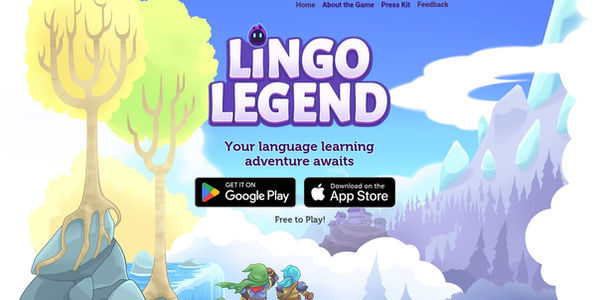
Best for: Gamers who want an actual video game that teaches French, not a quiz app dressed in game aesthetics.
Lingo Legend is the only app on this list that qualifies as a Level 3 game. It’s a full RPG card-battler combined with a cozy farm sim, developed by indie studio Hyperthought Games in Ontario, Canada. French lessons aren’t bolted onto the gameplay. They are the gameplay. You answer vocabulary and phrase prompts to power card abilities in battle, expand your farm, and progress through the adventure world of Yorthwood.
Key features:
Dual game modes: strategic RPG card-battler and relaxing farm sim, connected in one world
3,500+ words and phrases across 150+ categories covering practical topics (ordering food, meeting people, travel)
Spaced repetition system with varied question types including word-builder exercises and active recall
Supports both France French and Canadian French
Custom Curriculum lets you import your own vocabulary via CSV to align with a class or textbook
Multi-language study without losing progress when switching (10 languages available)
Monthly challenges, badges, leaderboards, guilds, and an active Discord community
Indie devs who are responsive on Reddit and Discord, shipping frequent updates
Pricing: Free to download with limited daily energy and optional rewarded ads. Subscriptions: $9.99/mo, $44.99/6 months, $69.99/year, or $129.99 lifetime upgrade.
Tradeoffs:
Not a full speaking or listening curriculum. It focuses on vocabulary, phrases, and grammar recall. You’ll still need a conversation practice tool for fluency.
English-only UI for now
10 languages available (the team is deepening existing courses before expanding, and you can vote for a future language)
Real user perspective: One Google Play reviewer noted that “the card combat is really fun with good cards to build a deck. For language learning, it’s enjoyable so far, flash cards with voiced words, and it’s repetitive enough to get it.” Another highlighted “quick lessons that can be done with sound or without, no fumbling with settings, and the gameplay makes users come back to learn throughout the day.”
If you searched for French game apps because you want something that actually feels like playing a game, Lingo Legend is the most obvious pick. It’s the rare app where the “game” part isn’t marketing spin.
2. Duolingo

Best for: Absolute beginners who need free access and daily habit scaffolding.
Duolingo is the most downloaded language app on the planet, with roughly 17 to 20 million people learning French on the platform. Its green owl mascot, streak system, and league leaderboards have made it synonymous with language learning apps. But is it a game? Not really. It’s a well-gamified quiz engine.
Key features:
Full French course accessible for free (the same curriculum that paying subscribers receive)
XP system, daily streaks, leagues, and achievement badges
Bite-sized lessons with translation, listening, and matching exercises
Stories feature for reading comprehension
10.9 million paying subscribers across all languages as of mid-2025
Pricing: Free tier includes the complete French course. Super Duolingo runs $9.99 to $12.99/month depending on plan. Annual pricing lands around $84 to $96/year. Family plan: $119.99/year for up to 6 accounts.
Tradeoffs:
Independent assessments put Duolingo’s practical ceiling for most learners at around A2 on the CEFR scale, roughly a low intermediate level
One user with an 842-day streak wrote that after 2.5 years, they were “still terrible at speaking and, especially, hearing it”
Duolingo teaches translation between English and French, which isn’t the same skill as actually speaking French
In 2025, CEO Luis von Ahn announced Duolingo would become an “AI-first” company, replacing contracted workers with AI. This sparked public outcry. The energy system rollout in July 2025 pushed many learners to look for alternatives.
Real user perspective: Reddit users frequently describe Duolingo’s biggest psychological flaw as the “illusion of progress.” Racking up XP feels productive but is mostly passive recognition. The Duolingo subreddit and Trustpilot reviews from late 2025 and early 2026 document a wave of users exploring alternatives.
Duolingo remains a solid free starting point, but if you’re looking for game apps specifically because Duolingo’s gamification isn’t cutting it, you’re not alone. If you’re also studying Japanese, this breakdown of Duolingo alternatives for Japanese learners covers similar ground.
3. Drops

Best for: Busy learners who want a beautiful, quick vocabulary game they can play in five minutes.
Drops strips language learning down to its fastest possible form: swipe and tap through illustrated vocabulary in timed sessions. It’s a Level 2 game-like experience. The mechanics are engaging without being complex.
Key features:
Beautiful visual design pairing words with custom illustrations
Fast-paced swipe and tap gameplay
50+ languages including French
Topic-based categories covering travel, food, business, and more
4.7 out of 5 on the Apple App Store from over 70,000 reviews and 4.3/5 on Google Play from 308,000+ reviews
Pricing: Free tier limits you to one 5-minute session every 10 hours. Premium: $13/month, $69.99/year ($5.83/month), or $159.99 lifetime.
Tradeoffs:
Vocabulary only. Drops does not teach grammar, sentence construction, or conversation.
The 5-minute free limit makes it extremely hard to learn French solely through Drops
No spaced repetition system, so retention relies on you showing up consistently
Real user perspective: Most users treat Drops as a supplement rather than a primary learning tool. The visual association method works well for concrete nouns (food, animals, objects) but struggles with abstract concepts and verb conjugations.
Drops is the perfect pairing app. Combine it with a grammar resource and a game app like Lingo Legend, and you’ve got visual vocab coverage alongside strategic practice.
4. Memrise

Best for: Learners who want real French audio and video exposure beyond robotic text-to-speech.
Memrise’s strongest selling point is its library of short video clips showing native French speakers using vocabulary in context, often in funny and memorable ways. The new AI Buddies feature, introduced in May 2025, adds grammar, role-play, translation, and culture practice through chatbot conversations.
Key features:
Native-speaker video clips for contextual vocabulary learning
AI Buddies for grammar and role-play conversations
Community-created courses alongside official content
Pronunciation practice with audio comparison
Pricing: Varies by region. Ranges from $14.99/month to $199.99 for lifetime. Annual plans around $62/year in some markets.
Tradeoffs:
Lacks comprehensive grammar lessons, making it more of a niche vocabulary builder
The user interface is often described as confusing and difficult to navigate
Quality of community courses varies wildly
Real user perspective: One teacher on G2 reported that “since I started using this app, my students have improved 150% in their retention of new vocabulary.” The native-speaker videos consistently get praised as the feature that sets Memrise apart from competitors using robotic voices.
5. LingoDeer

Best for: Grammar-focused learners who want clear explanations before jumping into game-style practice.
LingoDeer takes the opposite approach from most game apps. Instead of hiding grammar behind gameplay, it leads with detailed grammatical explanations and then reinforces them through quiz-style exercises. The French course guides English speakers from A1 (complete beginner) to B1 (lower intermediate).
Key features:
Structured lessons with detailed grammar explanations written specifically for English speakers
Native-speaker audio throughout
Progress tracking across A1 to B1 CEFR levels
LingoDeer Plus, a separate app with 7 mini-games for gamified practice (requires additional subscription)
Pricing: $12.99/month, $32.99 for 3 months, $76.99/year, or $119.99 lifetime.
Tradeoffs:
The French course isn’t very long compared to LingoDeer’s Asian language offerings, which are considered its strongest content
No leaderboards, group challenges, or social interaction features
The game elements are minimal in the main app. The actual games live in LingoDeer Plus, which costs extra.
LingoDeer pairs well with a game-focused app. Use LingoDeer for grammar clarity, then practice that vocabulary in a more engaging format elsewhere.
6. FunEasyLearn

Best for: Visual learners who want the largest possible word bank to drill through mini-games.
FunEasyLearn is a straightforward vocabulary trainer with a massive library. It won’t teach you to construct sentences or hold conversations, but if you want to rapidly build French word recognition across dozens of topics, the sheer volume is hard to beat.
Key features:
Over 15,000 words and phrases across 20+ languages
Multiple learning modes: flashcards, quizzes, matching games, and spelling exercises
Offline access for studying without internet
Illustration-based learning for visual association
Pricing: Free with limitations. Premium subscription unlocks the full library (pricing varies by platform and region).
Tradeoffs:
Vocabulary only, with no grammar instruction or sentence building
Game mechanics are basic (matching, multiple choice) rather than strategic or narrative-driven
It won’t teach you to debate politics in French, though it will get you labeling everyday objects quickly

Best for: Kids and absolute beginners who want a completely free, zero-commitment game.
Infinite French takes a space theme and turns French vocabulary into a meteor-tapping arcade game. It’s simple, colorful, and completely free with no subscriptions. An optional $4.99 upgrade exists but isn’t required to access the core experience.
Key features:
Multi-sensory learning combining text, audio, and visual icons
Built-in spaced repetition system
Offline study capability
Space-themed immersive gameplay
Pricing: Completely free. Full feature access with no subscriptions. Optional $4.99 upgrade.
Tradeoffs:
The app doesn’t show the gender of nouns, which is a crucial omission for French where every noun is masculine or feminine
The word bank is limited, and the vocabulary choices can be unusual
Very basic compared to other French game apps on this list. It’s a good starting point, not a destination.
8. Clozemaster

Best for: Post-beginner learners who want contextual vocabulary practice in a retro-game format.
Clozemaster fills a gap that most French game apps ignore: the intermediate plateau. Instead of teaching basic vocabulary through flashcards, it presents French sentences with one word missing and asks you to fill in the blank. The retro arcade aesthetic gives it a distinctive feel.
Key features:
Context-based cloze (fill-in-the-blank) sentences drawn from a large corpus
Retro arcade visual design with points and leveling
Focuses on high-frequency vocabulary in context
Spaced repetition built into the review system
Listening and text input modes
Pricing: Free tier with limited daily sentences. Pro subscription around $8/month.
Tradeoffs:
Not suitable for beginners who lack basic French vocabulary and grammar
The retro interface is polarizing: some find it charming, others find it dated
No speaking practice, video content, or narrative elements
Clozemaster is the app you graduate to after building a foundation with one of the other French game apps on this list. It’s particularly effective when paired with a game-based app for daily motivation.
How to Choose the Right French Game App
The right app depends on what kind of learner you are, and most people benefit from combining two.
If you’re a gamer: Start with Lingo Legend. The RPG card battles and farm sim will keep you coming back in a way that quiz apps simply can’t replicate. Pair it with LingoDeer or a grammar textbook for structural understanding.
If you’re budget-conscious: Duolingo’s free tier gives you the complete French course. Supplement with Infinite French for extra game-style practice at zero cost.
If you’re visual: Drops is the most beautifully designed vocabulary app on this list. Use it for quick daily sessions and complement with something that covers grammar.
If you want native audio: Memrise’s video clips offer real French speaker exposure that other apps approximate with text-to-speech.
If you’re intermediate and plateauing: Clozemaster’s contextual fill-in-the-blank format will push your vocabulary forward when basic apps feel too easy.
If you have kids learning French: Infinite French’s free space game works well for young beginners. Lingo Legend’s farm sim mode appeals to older kids who enjoy strategy games.
The most effective approach is a stack: one game app for daily engagement, one grammar resource for structure, and one speaking tool (like a tutor or conversation exchange) for output practice. For more language learning strategies, check out the Lingo Legend blog.
If you’re studying multiple languages simultaneously, Lingo Legend supports switching between 10 languages without losing progress in any of them, including Mandarin and Japanese.
FAQ
Can you really learn French from a game app?
You can build a strong vocabulary foundation, learn common phrases, and develop reading recognition through French game apps. But speaking fluency requires speaking practice, and grammar mastery requires structured study. The best results come from using a game app as your daily engagement tool alongside other resources. Research on desirable difficulties suggests that game mechanics which require active recall (like answering correctly to power a combat ability) create stronger memories than passive multiple-choice tapping.
What’s the best free French game app?
Duolingo offers the most complete free experience, giving access to its entire French course without paying. Infinite French is completely free with no subscription at all, though its vocabulary library is limited. Lingo Legend offers a free tier with limited daily energy and optional rewarded ads, which gives enough play to evaluate whether the RPG and farm sim mechanics work for you.
Are French game apps better than Duolingo?
They serve different purposes. Duolingo excels at building a daily habit with zero financial commitment, but its gamification is designed more for engagement than deep learning. Reddit users consistently describe Duolingo as an “entry-level habit-builder rather than a primary path to fluency.” Apps like Lingo Legend that embed French into actual gameplay tend to produce more active recall, which is the type of practice that sticks in long-term memory. The honest answer: use both if they serve different needs.
How long does it take to learn French with an app?
The FSI estimates French requires about 600 to 750 class hours for English speakers to reach professional proficiency. No app alone will get you there. Apps are best for the first 100 to 200 hours: building vocabulary, internalizing common phrases, and developing daily study habits. Most learners reach a basic conversational level (A2) within 3 to 6 months of consistent daily practice with a good app, then need conversation practice and immersion to progress further.
Can kids use these French game apps?
Infinite French is the most kid-friendly option since it’s free, simple, and has a colorful space theme. Lingo Legend’s farm sim mode appeals to older kids (roughly 10+) who enjoy strategy games. Duolingo’s cartoon style works for younger users, though the social features (leagues, friend lists) warrant parental awareness. On the Lingo Legend subreddit, parents have discussed family sharing and kid use, with the dev team offering guidance on setting things up across platforms.
Do I need to pay for a French game app to get results?
Not necessarily. Duolingo’s free tier covers the full French course. But paid apps tend to offer deeper content, fewer interruptions, and more sophisticated learning mechanics. Lingo Legend’s free tier lets you play daily with limited energy, which is enough to evaluate the approach. If a game app keeps you studying for 15 minutes a day when you’d otherwise skip practice entirely, the subscription pays for itself in consistency.
![Please in German (Bitte): 7 Meanings, Examples [2026]](https://static.wixstatic.com/media/7bc962_4ba7da9021c8414da27ccf0150bba067~mv2.avif/v1/fill/w_600,h_300,al_c,q_80,enc_avif,quality_auto/7bc962_4ba7da9021c8414da27ccf0150bba067~mv2.avif)


Comments